
Spring Boot vs Quarkus in 2026

TL;DR ##
Quarkus is technically impressive and excels in native and cloud-native scenarios, but Spring remains the safer enterprise choice due to ecosystem size, hiring market, and community maturity.
When I’d pick Quarkus
- Serverless / scale-to-zero workloads (startup + memory matter)
- High-density microservices where RAM is the real bottleneck
- Teams comfortable with native-image constraints and build-time optimization
When I’d pick Spring Boot
- Enterprise apps with lots of integrations and long maintenance horizons
- Teams hiring frequently (bigger talent pool)
- Projects relying heavily on Spring ecosystem modules and conventions
---
Quarkus? I Almost Forgot About It
An agency recently contacted me for a contract requiring Java with Quarkus (and not Spring). Now, that was a surprise.
I remember being very interested in Quarkus when it was introduced in 2019, presented as a modern re-architecture of Java EE components for cloud-native environments. The framework, backed by Red Hat (still a cool company at the time and I had some cool friends working there), aimed to be the new kid on the block for microservices.
The idea was clever—reuse Java EE (now Jakarta EE) implementations in a new "cloud-native" platform leveraging GraalVM, blending the reliability of old standards with the efficiency of modern technologies.
The first demos were impressive. Conferences were buzzing with Quarkus promotions. Sure, there were initial issues—that’s expected—but maybe they slowed down its adoption.
In the past few years, I barely heard anything about Quarkus. It doesn’t appear as frequently in enterprise tech stacks compared to Spring.
Then, last week, I saw a major Swiss insurance company looking for Quarkus developers. That got me curious—what’s the status of this framework today?
After publishing the original post, I saw 3 other important financial companies in Switzerland using Quarkus :)
---
Job Market: Spring vs. Quarkus
The job market is a good indicator of a technology's adoption. So, I ran a quick search across job websites:
- jobs.ch
- Java Spring: 128 jobs
- Java Quarkus: 11 jobs
- itjobswatch.co.uk
- Spring: 154 jobs
- Quarkus: 1 job
- dice.com
- Java and Spring: 1,635 jobs
- Java and Quarkus: 0 jobs (yes, zero!)
This says nothing about Quarkus’ technical quality. It only reflects market demand and hiring risk.
Six years after its launch, Quarkus has barely made a dent in the job market. That’s a major risk for developers specializing in it. Sure, they can switch to Spring or other Java technologies, but specializing exclusively in Quarkus may carry higher market risk compared to Spring. ---
GitHub Activity
On GitHub, Quarkus is very active, with 100–200 commits per week—more than Spring Framework’s core repository. However, Spring is a massive ecosystem with multiple sub-projects (Spring Data, Security, etc.), so the total activity across the Spring ecosystem is much higher.
Still, Quarkus' ongoing development is a positive sign.
---
Corporate Backing
Both frameworks are open source, but long-term investment still matters: paid maintainers, release cadence, and enterprise support influence the roadmap.
- Quarkus is led by Red Hat (owned by IBM).
- Spring is developed by the Spring team and is now part of Broadcom via the VMware acquisition (Spring has changed “homes” more than once over the years).
For most developers, this makes little difference day-to-day, but for long-lived enterprise systems, it’s reasonable to consider who is investing in the core team and ecosystem.
Anecdotally, I’ve noticed that Spring is often used as the “reference framework” in official demos and training content (including some vendor materials), while Quarkus appears more frequently in cloud-native and native-image focused contexts.
---
Stack Overflow: The Old AI
Before AI took over, Stack Overflow was the go-to resource for developers. It’s still useful for measuring adoption and community support.
- Quarkus: 4,800 questions
- Spring: 212,000 questions
Once again, the numbers don’t lie—Quarkus has limited adoption and support compared to Spring.
---
What Are the Advantages of Quarkus?
Despite its niche status, Quarkus still maintains an edge for native and cloud-native applications:
- Lower memory consumption: 30-40MB vs. Spring's 150MB (assuming unfair comparison between default implementation: Quarkus native vs Spring Boot JRE).
- Faster startup time: 0.1 sec (native GraalVM) vs. 5-10 sec (Spring).
- It doesn't use CGLIB by default (see my post about CGLIB vs Interfaces)
- Native first Quarkus compiles in native Graal VM, removing the need for the runtime JVM.
- Ecosystem Quarkus uses a lot of community-driven technologies. This could be seen as a more 'open' environment.
- AOT: ahead-of-time compilation Quarkus optimizes the code for the JVM as well. Spring has AOT too and it's improving, but we can feel that it's a catch up.
- UI dashboard Quarkus comes with a rich Dev dashboard, Spring doesn't have anything similar out-of-the-box. In Spring you can use Actuator with external tools (Actuator is for Dev AND Prod).
- Optimized Build Quarkus customizes the build process to avoid unnecessary classpath scanning and unused features.
- Continuous Testing Quarkus automatically reruns only the tests impacted by the developer's changes. In Spring we tend to have a 'separate' test phase.
- Unified Reactive and Imperative In Spring you have 2 different libraries (WebFlux, MVC) for reactive and imperative APIs. Quarkus is built on a reactive core (Vert.x) but supports both imperative and reactive programming models.
- Spring compatibility Quarkus is compatible with many Spring annotations, reducing the burden in case you want to migrate from Spring Boot.
- Dependency Injection Quarkus performs as much of the injection as possible at build time, Spring performs injection at runtime.
- Persistence Quarkus supports Hibernate Reactive and uses beans, Spring uses proxies.
If you use 'serverless' applications (GCP Cloud Run etc.) or you are strongly in microservices, then Quarkus is a great fit and for the infrastructure as great features. For a standard enterprise application ... Spring is still the king.
I want to add here Quarkus has direct links to Hibernate, some of the leaders of Quarkus come from Hibernate. As we know, Hibernate is a king in the Java enterprise applications and this helps Quarkus to work smoothly with the persistence layer.
---
Save cloud money
In an interview somebody asked to Adam Bien why use Quarkus ... he simply answered ... 'to save money'.
I tried to migrate an application from Spring Boot to Quarkus, the application is using a PaaS (Jelastic) that bills based on resource consumption.
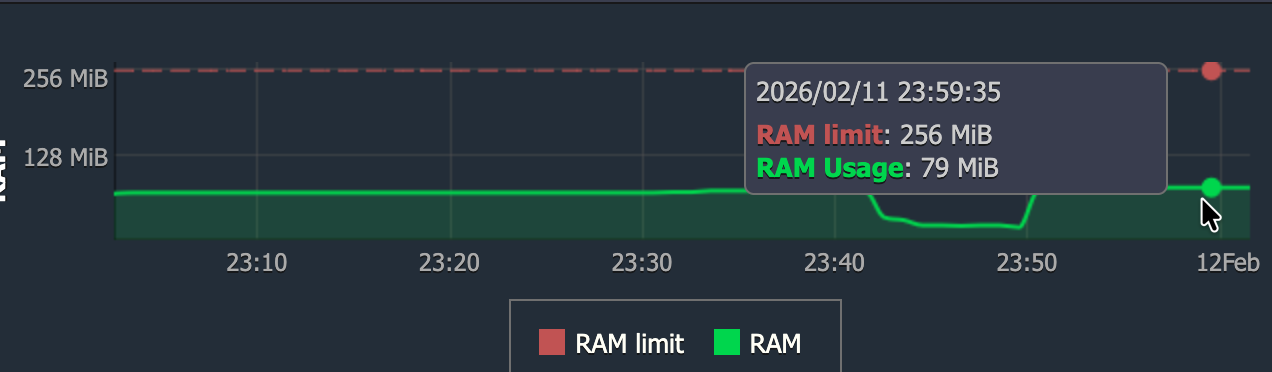
I didn't optimize the Spring Boot application with AOT or native Spring, so it's not really a benchmark or a fair comparison, but Quarkus uses 1/3 of the resources.
I quickly tried to migrate the application from Spring Boot to AOT, but it broke (skill issues I imagine). The advantage of Quarkus is that is 'native' out of the box.
Quarkus (using GraalVM) uses 79 MB:
Spring Boot (using JRE) uses 285 MB:
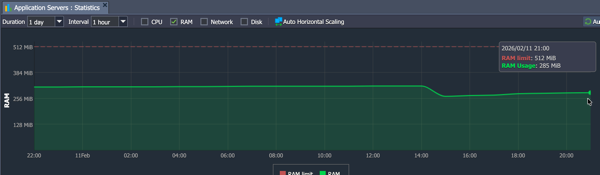
Using Jelastic Infomaniak, the cost difference is important. The cloudlets are 128 MB, with Quarkus I need to pay for 1 cloudlet. For Spring Boot I need to pay for 3 cloudlets.
Community oriented
Both Spring and Quarkus have strong communities and active maintainers.
Quarkus deserves a mention for its community calls: it’s relatively easy to interact with maintainers and follow roadmap discussions. Spring’s ecosystem is enormous and mature, but the interaction pattern is different — many users, lots of Q&A, and a very broad set of sub-projects.
If I can compare to Linux communities, I can imagine that Spring is the Ubuntu of Java and Quarkus is the Fedora of Java (well, Fedora and Quarkus come from the same company).
---
Tech Stack
| Layer | Spring Boot (The "Enterprise Standard") | Quarkus (The "Cloud-Native Engine") |
|---|---|---|
| Development API | Spring Framework (de facto standard) | Jakarta EE & MicroProfile (de jure standards) |
| Core Engine | Spring Context / Spring Bean Container | Vert.x (High-performance Reactive core) |
| Dependency Injection | Spring DI (Runtime Proxying) | ArC (Build-time CDI implementation) |
| Web / REST | Spring MVC (Servlet-based) or WebFlux | RESTEasy Reactive (Non-blocking by default) |
| Database (ORM) | Spring Data JPA (Wrapper around Hibernate) | Hibernate Panache (Active Record/Repository) |
| Reactive Core | Project Reactor / Flux / Mono | Mutiny (Uni / Multi) |
| Runtime Container | Embedded Tomcat (Default) or Jetty/Undertow | Netty (via Vert.x) |
| Native Engine | Native support via Spring Boot 3/4 and GraalVM | GraalVM (Integrated first-class support) |
---
Automatic Build and Refresh
Quarkus by default rebuilds and redeploys the project, this feature was a selling point when Quarkus came out. Spring has its own Dev mode that is very similar.
I used the Dev mode of Spring for small projects, for enterprise solutions we prefer to have a standard build and create unit tests before the local deployment.
I think that Quarkus has some advantages (recompiles and redeploys only the changes), being built with this feature, but it's not something that is very critical in the development.
---
My Opinion
Everyone has their own take, but for me, Quarkus could be a great fit for extreme microservices architectures (think Netflix-scale). Quarkus has the advantage to have been built trying to solve all the potential issues of Spring Boot.
For the enterprise world, where I see most real-world use cases, saving a few MB per fat-JAR isn’t significant. When you package everything into Docker containers with Linux, an extra 100MB is irrelevant.
The 0.1-second startup time is cool, but only applies when compiling to native GraalVM. In practice, during development, Quarkus is usually faster than Spring, but developers should focus on unit tests, not framework startup speed. And in production, rolling deployments ensure the new instance is ready before the old one shuts down—neutralizing Quarkus’ startup time advantage.
There are advantages for the Developer Experience with Quarkus, but with Spring it's easier to find solutions to the issues, having more users and feedbacks. With the rise of AI-assisted and “vibe” coding, developer experience becomes slightly less critical than long-term maintainability and ecosystem maturity.
---
Conclusion
I love having alternatives in the Java ecosystem. Competition drives innovation. But I’m honestly surprised that Quarkus hasn’t gained real-world traction; it remains a niche framework.
If I were starting a new project today, I might give Quarkus a quick evaluation, but I’d almost certainly choose Spring.
Using niche technologies in enterprise projects is risky if key developers leave or unexpected issues arise, you could be in serious trouble.
I heard that one of the companies using Quarkus had serious issues finding developers.
The other doubt I have is the 'engagement' of IBM in the Quarkus project, Red Hat and Spring Source were direct competitors 'fighting' to be the best framework for Java developers. My feeling is that Quarkus is not a 'flagship' technology for IBM (that adopted Spring) with the risk to 'leave to the community' the future of the framework.
What do you think? Any positive experience?


